
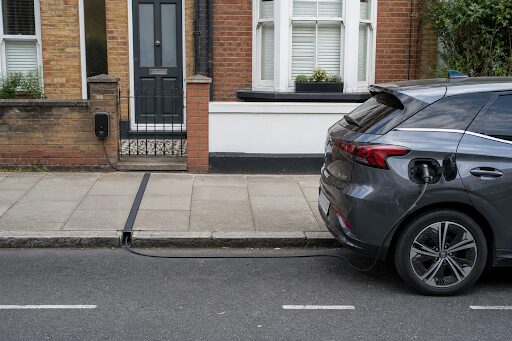
Not every home comes with a driveway. That should not mean you are locked out of convenient EV charging. A cross-pavement charging solution helps you charge an electric vehicle from your home supply when your car is parked on the street, without leaving a loose cable trailing across the pavement. In simple terms, it gives your charging cable a safer, tidier route between your home charger and your EV.
At The Full EV, we see this as a practical option for drivers who want the benefits of home charging but lack private off-street parking. It is not a DIY shortcut or a “that’ll do” cable cover situation. Done properly, it needs the right permission, the right product, and a properly planned charger installation.
What is a cross pavement charging solution?
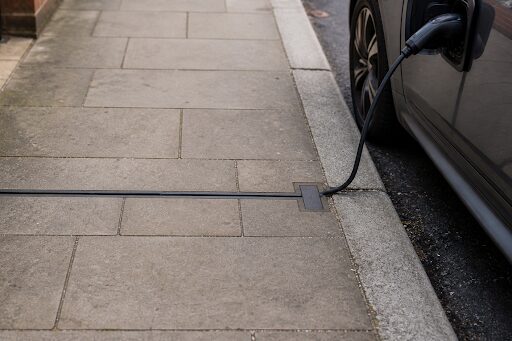
A cross-pavement charging solution allows an EV charging cable to pass across or through the pavement in a controlled manner. The most common option is a cable channel or gully set into the pavement, so the cable can sit inside it while charging rather than lying loose across the walking surface.
Official cross pavement charging guidance explains that cable channels, often called gullies, are one of the main ways to make home charging safer for households without off-street parking.
The point is simple:
- Reduce trip hazards
- Avoid loose cables across walking routes
- Make home charging possible for more EV drivers
- Keep the pavement as clear and accessible as possible
- Help drivers rely less on public chargepoints
It is a practical infrastructure. Not glamorous, perhaps, but neither is a plug socket until your battery is low and you need the car in the morning.
Why cross pavement EV charging matters
Home charging is often the easiest way to run an EV. You can plug in when the car is parked, charge at convenient times, and make better use of smart tariffs. For homes without off-street parking, the awkward part has always been the cable route. A home charger can usually be fitted on a suitable exterior wall, subject to survey and electrical checks, but the cable still has to reach the vehicle safely.
A loose cable across the pavement can create a trip risk, especially for people using wheelchairs, pushchairs, walking aids, or mobility canes. Pavements need to work for everyone, which is why inclusive mobility guidance is relevant when planning any charging route across a public walking space. We have already looked at this issue in our article on how a pavement channel can solve the home charging challenge, and it is becoming a more relevant option as more drivers look beyond public charging.
How this charging solution works
The exact setup depends on the property, pavement, parking position, and permission route. In most cases, the process follows a similar path.
Check whether your parking setup is suitable
You need to be able to park close enough to your property for the cable to reach safely. A cross-pavement solution does not reserve the parking space outside your home. If the space is taken, you may not be able to charge that day.
A suitable setup usually depends on:
- Regular access to lawful on-street parking
- Enough pavement width for safe installation
- No obvious conflict with crossings, drains, covers, or street furniture
- A practical route between the chargepoint and the kerb
- Permission before work starts
Choose the right type of pavement solution
Most drivers will be looking at an in-pavement channel. This is a narrow, flush channel that holds the cable while charging. Once charging is finished, the cable is removed and stored away. Some systems use a fixed route beneath the pavement with a connection point nearer the kerb. These may suit certain situations, but they usually involve more detailed installation and approval requirements. Temporary cable covers may look easier, but they are not the same as a properly installed cross pavement solution. Current official chargepoint grant guidance states that temporary covers or mats placed over a cable do not count as qualifying cross-pavement solutions for the household on-street parking grant.
Plan the charger around the cable route
The pavement channel is only one part of the setup. You still need a safe, compliant home chargepoint installed by a qualified professional. The charger location, cable length, electrical capacity, earthing arrangement, load management, and smart charging features all need checking. The charger also needs to work with the approved pavement route, so the cable does not become stretched, twisted, or awkward to store.
This is where early planning helps. The charger should not simply be fitted wherever there is a spare patch of wall. It needs to suit how you park, how often you charge, where the cable will run, and what your home electrical supply can support. If you are exploring this type of setup, our home EV charger installation service is a practical place to start. We can help assess the charger side of the project, from choosing a suitable unit to planning a neat, safe installation that works with real parking habits.
Use the system properly after installation
Once installed, the cable should only sit in the channel while charging. After charging, it should be removed from the pavement route and stored safely. It is basic housekeeping, but it matters. Even a good system can become a nuisance if it is used carelessly.
Comparing options
| Option | How it works | Best suited to | Key consideration |
| In-pavement cable channel | A narrow channel holds the cable while charging | Homes where the vehicle can usually park close by | Usually needs permission and proper installation |
| Under-pavement connection | A fixed route runs below the pavement to a kerbside point | More complex setups | May need more technical checks |
| Temporary cable cover | A cover sits over a cable on top of the pavement | Short-term situations where allowed | Not the same as a permanent solution |
What permission do you need?
This is the part worth checking before anyone books an installation. Because pavements and roads are not private property, you should not install a cross pavement charging solution yourself. Before anything is cut, lifted, drilled, or booked, the permission route needs to be confirmed.
That may include:
- Permission from the relevant authority
- Any required planning permission
- Agreement from a landlord, freeholder, managing agent, or property owner
- Confirmation that the installation meets local requirements
- A suitable installer for the chargepoint and electrical work
Policies are still being shaped, so approval routes can vary. The safest approach is to check first, then install. Not the other way round. A pavement is not the place for cowboy enthusiasm.
Can you get a grant for cross-pavement EV charging?
There is grant support available for eligible households installing a chargepoint alongside a qualifying cross pavement solution. The key point is that the grant cannot normally be used after the work has already been completed. You need to check eligibility and follow the correct process before installation.
Typical eligibility points include:
- You live in the property as an owner or tenant
- You do not have private off-street parking
- You own or are responsible for an eligible vehicle
- You are installing a qualifying cross pavement solution
- You have the right permission for the pavement works
- You use eligible equipment and an approved installer
The grant does not give you a dedicated parking space. So even if funding is available, the parking situation still needs to make sense.
What makes a good cross pavement charging installation?
A good installation should be boring in the best way: neat, safe, and easy to use. The channel should sit flush, the charger should be sensibly positioned, and the cable route should work in real life, not just on a sketch. Before any charger installation is recommended, we look at practical details such as where the vehicle usually parks, whether the cable route is realistic, how the charger will sit on the property, and whether the home supply is suitable.
Electrical suitability
Your home supply needs a proper assessment. A chargepoint is not just another outdoor socket. Load management, earthing, consumer unit condition, and network notification or approval may all come into play.
Parking behaviour
If you can only park near your property once in a blue moon, a cross-pavement solution may not be the best investment. If you can usually park close by several times a week, it may be far more useful.
Charger speed and charging habits
Many homes use a 7kW charger because it suits typical overnight charging. Faster does not always mean better, especially when the car is parked for hours. The right charging speed depends on the vehicle, property, electrical supply, and charging routine. Our comparison of 7kW vs 22kW EV charging explains the practical difference.
Cable length and charger position
A tidy cable route is safer and easier to live with. Too short, and it becomes awkward. Too long, and it becomes messy. The charger and pavement route should be planned as one system, not two separate decisions.
Is this type of charging right for you?
A cross-pavement charging solution may be worth exploring if:
- You do not have a driveway or private parking space
- You can usually park close to your home
- You want access to home charging and smart tariffs
- You want to rely less on public charging
- You are willing to follow the proper permission route
It may be less suitable if parking near your home is highly unpredictable, the pavement route is unsuitable, or permission is unlikely to be granted.
The key takeaway
Cross pavement charging is not a workaround. It is a proper infrastructure solution for a real problem: how to charge at home when your EV parks on the street. Done well, it can make EV ownership easier, safer, and more convenient for households without off-street parking. Done badly, it can create trip hazards, permission issues, and a headache nobody ordered.
Our advice is simple. Start with the parking setup, check the permission route, choose the right charging equipment, and use qualified installers who understand EV charging properly. If you are unsure whether your property is suitable, start by looking at the charger side of the setup. Our home EV charger service page explains how we can help you plan and install a practical charging solution that works safely, neatly, and properly from the beginning.

