
Fleet electrification is often seen as a vehicle decision. In practice, it is just as much an infrastructure decision. You can choose the right vans, cars or light commercial vehicles, but if the charging setup does not reflect how your fleet actually runs, the whole plan can become awkward very quickly.
That is why EV charging infrastructure matters so much. It is what makes the shift to electric vehicles workable day-to-day. When charging is planned properly, vehicles are ready when they need to be, energy use is easier to manage, and your business is less likely to depend on public charging as a daily fallback. For us, that is where the real work begins. Fleet charging is not just about installing chargepoints. It is about building a charging system around vehicle use, site constraints and future growth.
Why EV charging infrastructure matters in fleet operations
A fleet can only electrify successfully if charging fits around the working day rather than interrupting it. That may sound obvious, but it is where many projects either settle into a smooth routine or become a collection of small frustrations. Drivers lose time. Dispatch teams have less certainty. Costs become harder to predict. What looked straightforward on paper starts to feel less tidy in the yard.
Well-planned EV charging infrastructure helps prevent that. It allows vehicles to charge when they are already stationary, supports better control over site energy use, and reduces unnecessary reliance on public charging for routine operations. It also sits within a wider shift in transport. According to the government’s 2024 provisional greenhouse gas emissions statistics, domestic transport remained the UK’s largest emitting sector in 2024, accounting for 30% of total emissions.
For businesses reviewing their fleet strategy, that makes infrastructure more than a technical add-on. It becomes part of the wider operational and environmental case for electrification.
What EV charging infrastructure actually includes
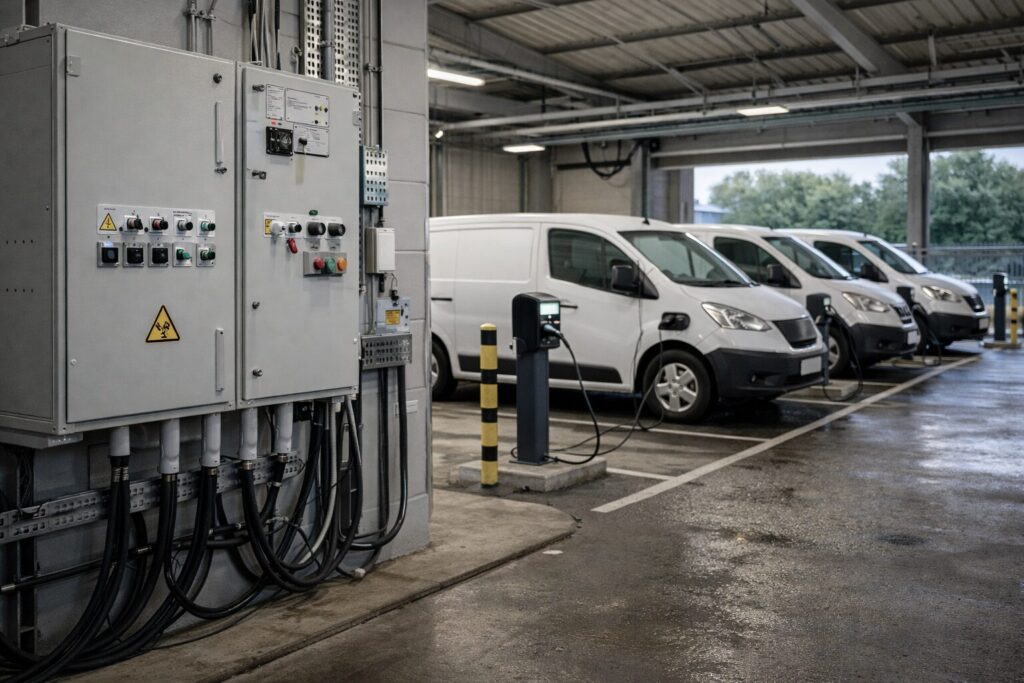
When people hear the term EV charging infrastructure, they often picture a charger on a wall and stop there. In practice, it is a broader system.
The visible elements
This is the part most people notice first:
- the chargepoints themselves
- the parking bay layout
- cable reach and cable management
- signage and access arrangements
The operational elements
This is usually what decides whether the setup works well in practice:
- site surveys
- electrical capacity checks
- load balancing
- charger management software
- scheduling controls
- reporting and usage visibility
- maintenance support
The future-proofing elements
This is the part that saves frustration later:
- spare capacity planning
- infrastructure for extra chargers
- phased installation routes
- flexibility for different vehicle types as the fleet grows
The charger itself matters, but the wider system is what decides whether it works well in practice. A business can install good hardware and still end up with a poor result if the layout is awkward, capacity is limited, or access is poorly managed.
How EV charging infrastructure supports fleet electrification in practice
Charging infrastructure is not just there to supply power. It needs to fit the way the fleet actually runs.
That means vehicles are charging during planned downtime rather than losing productive hours in the middle of the day. It means having enough visibility to know which vehicles are ready, which are charging, and how energy is being used across the site.
An effective charging infrastructure can help you:
- Charge vehicles overnight or during known dwell periods
- Prioritise vehicles needed first, the next day
- Reduce detours to public charging locations
- Make better use of lower-cost charging windows
- Monitor charging sessions and charger performance
A business with a handful of company cars has very different charging needs from an operation running vans on fixed schedules. Fleet charging needs vary quickly from one operation to another, which is why decisions around charger speed, dwell time, energy capacity and future expansion need to reflect how the vehicles are actually used.
A good example of that can be seen in our Barry Council EV charging infrastructure upgrade. The project involved reviewing electrical supply, managing the upgrade process, and recommending 7kW AC overnight chargers to match the duty cycle of the council vehicles. It is a useful reminder that fleet charging decisions are usually shaped by day-to-day operations rather than by charger specifications alone.
If you are weighing up what the right setup looks like for your own operation, our fleet EV charging service explains how we help businesses plan charging infrastructure around real fleet demands. If you are ready to explore the next step, it is a useful place to start.
Why public charging cannot do the whole job
Public charging still has a place in many fleet strategies. It can provide flexibility for drivers who are away from base and help cover occasional top-ups.
But public charging is built around shared access. Fleet operations usually need more certainty than that. Businesses need to know that vehicles can be charged when required, at a predictable cost, and without avoidable delays.
| Approach | Strengths | Common limitation |
| Public charging only | Useful for occasional top-ups and route flexibility | Availability, dwell time and pricing are less predictable |
| On-site charging infrastructure | Better operational control and alignment with fleet routines | Requires upfront planning and installation |
| Mixed model | Combines control with flexibility | Still needs a clear charging policy and good management |
For many fleets, a mixed model makes sense. On-site EV charging infrastructure handles the regular pattern, while public charging fills gaps where needed. It is often the most practical route, especially in the earlier stages of electrification.
How to plan EV charging infrastructure for a fleet
Getting the planning sequence right makes a big difference. This is one of those jobs where doing the homework first saves a lot of bother later.
Step 1. Review how the vehicles are actually used
Start with mileage, route lengths, shift times, dwell periods and return-to-base habits. A fleet of vans parked overnight needs a very different setup from a fleet that cycles in and out throughout the day. That operational picture tells you more than any product sheet ever will. It helps you judge how many chargers may be needed, what output makes sense, and whether charging can be staggered without disrupting the working day.
Step 2. Check the site’s electrical capacity
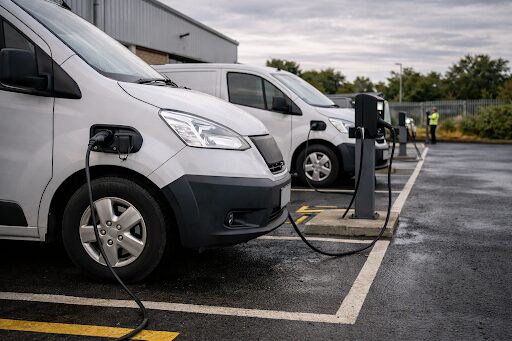
Electrical capacity is one of the biggest practical constraints in any charging project. It affects how many chargers can run, what power levels are realistic, and whether upgrade work may be needed. In practice, site capacity is often one of the first issues that shapes the final design, particularly where several vehicles need to charge within the same operating window. That is one reason smart charging and load management matter so much once fleets begin to scale.
The Energy Saving Trust’s guide to charging business electric vehicles makes the same point, noting that for most EVs, 7kW or 22kW fast chargers are often the best options for overnight charging, with the final choice depending on fleet use and site conditions.
Step 3. Match charger speed to the real use case
Not every fleet needs rapid charging. In many cases, lower-powered AC chargers are entirely suitable if vehicles are parked for long enough. That is where a solid understanding of charger output matters. Our guide to 7kW vs 22kW EV charging is useful here, because the right charger speed should reflect operational need rather than the temptation to choose the fastest option available.
For fleets parked overnight, slower AC charging is often the better fit than businesses first expect. It can be simpler to install, easier on the site’s electrical supply, and entirely practical where vehicles have long dwell periods.
Step 4. Add smart controls
Smart charging helps distribute available power, control charging times, manage access and improve reporting. Once a fleet starts to grow, that level of control becomes increasingly useful.
Software might not be the glamorous part of the project, but then neither is the fuse board, and both tend to matter greatly once the real work begins.
Step 5. Plan for growth
Most businesses do not electrify the entire fleet in one go. They add vehicles in phases, often as leases end or replacement cycles come round. Good EV charging infrastructure should allow for that. Planning the wider infrastructure now can make later expansion much easier and less disruptive.
Common mistakes that make electrification harder than it needs to be
A lot of trouble comes from getting the order wrong.
These are some of the most common mistakes:
- Choosing chargers before understanding vehicle duty cycles
- Underestimating site power constraints
- Assuming every vehicle needs the same charging speed
- Treating software and access control as optional
- Installing only for the first phase, with no room for growth
- Relying too heavily on public charging to cover daily operational needs
None of these mistakes looks dramatic in a project document, but they can create daily friction once the fleet is live. And daily friction has a habit of turning into cost.
Grants can help, but they should not drive the whole plan
A strong charging strategy should start with operational needs first, then look at funding support. That said, available grants can still make a meaningful difference. The official Workplace Charging Scheme offers eligible organisations support towards the cost of installing workplace chargepoints. It covers up to 75% of purchase and installation costs, capped at £500 per socket for installations completed on or after 1 April 2026, and the scheme has been extended until 31 March 2027.
That is worth reviewing alongside our guide to government grants to help companies shift to electric vehicles, which gives a practical overview of the support currently available for businesses considering the switch. The important thing is not to let the grant decide the design. A cheaper setup is not automatically the right one if it does not support how your fleet actually operates.
What a good EV charging infrastructure looks like day to day
The best fleet charging setups usually look unremarkable in the best possible way. Drivers know where to charge. Vehicles are ready when they are needed. Charging happens during planned downtime. Energy use is easier to track. Expansion is possible without starting from scratch.
That is usually the sign that the charging setup has been planned properly. It becomes part of normal operations rather than a separate project that keeps demanding attention. For us, that is the aim. Not a charging setup that looks impressive in a brochure, but one that makes everyday fleet use simpler, steadier and easier to scale.
The key takeaway
Fleet electrification only works smoothly when charging is treated as infrastructure rather than an afterthought. That means looking beyond the charger itself and focusing on how the wider setup supports your vehicles in real use. Charger speed, site capacity, software controls, charging patterns and future growth all matter. Public charging can still play a useful supporting role, but dependable on-site EV charging infrastructure is usually what makes electrification workable in practice.

